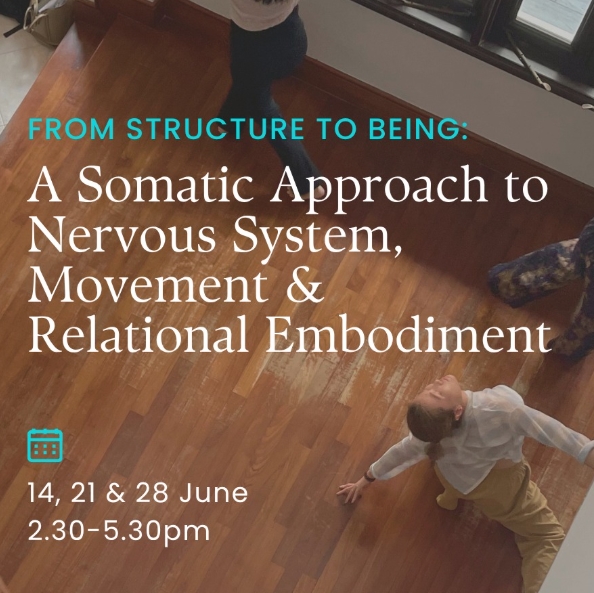
From Structure to Being: A Somatic Approach to Nervous System, Movement & Relational Embodiment
Program Description
The body is always in conversation - with gravity, with space, with self and other.
In this experiential curriculum, we explore how nervous system awareness and creative movement shape our capacity for connection and relationships.
Drawing from Body-Mind Centering®, Contact Improvisation and the polyvagal framework integrate psychophysical systems as somatic foundation, this training will touch on embodied relational practices that invite participants to investigate the body-mind beyond just an object to be shaped, but as a living system of intelligence - one that continuously adapts, protects, relates, and expresses.
Across three modules, we explore:
1. Developmental movement patterns and nervous system states
2. Fascia as a sensory and relational organ
3. Organ-based vs muscular approaches to movement, especially in trauma contexts
Practices include guided movement in solo exploration and contact improvisation, relational exploration, and reflective integration. Participants will develop a nuanced capacity to sense, track, and work with the body as a biodynamic container of consciousness and creativity.
Learning Outcomes
- Cultivate nervous system literacy through a sensory-based approach
- Understand developmental movement patterns and their impact
- Experience fascia as a sensory system
- Differentiate muscular vs organ-based movement
- Integrating trauma-informed somatic principles
- Develop relational attunement and co-regulation skills
Module 1: Developmental Patterns & the Nervous System
Focus: Repatterning movement and nervous system states
Key Themes:
- Developmental movement patterns (yield, push, reach, grasp, pull)
- Mapping movement to in our developmental process and nervous system states
- Regulation vs dysregulation
Experiential Components:
- Yielding vs Bracing vs Collapsing
- Boundary exploration through pushing
- Reaching and orienting
- Dyadic relational movement
- Improvisational integration
Module 2: Fascia, Sensation & Emotional Physiology
Focus: The body as a sensory and relational field
Key Themes:
- Fascia and nervous system connection
- Interoception, proprioception, neuroception
- Myofascial meridiens in touch & movement
Experiential Components:
- Understanding fascia as a matrix system in how they shape our body-mind
- Fascia qualities – viscosity, directionality. elasticity, plasticity
- Oscillation practices
- Relational sensing exercises
- Subtle unwinding practices
Module 3: Organs, Support & Trauma-Informed Movement
Focus: From effort to embodied support
Key Themes:
- Muscular vs organ-based movement
- Trauma and bracing patterns
- Organs as support and emotional regulation
Experiential Components:
- Effort-based vs support-based movement comparison
- Organs as fluids
- Dyadic relational practices
- Improvisational integration
Pedagogical Tools
• Somatic explorations through the body systems (BMC)
• Developmental movement patterns as therapeutic repatterning
• Touch in trauma healing: ethics, presence, and attunement
• Emotional reflection through journaling, art, dialogue
• Group explorations and peer witnessing
• Visual maps of nervous system states and relational dynamics
This series invites a shift from understanding the body to listening to it—from shaping movement to being shaped by it, from doing to inhabiting.
No prior movement experience is required. This training is open to therapists, movers, and anyone curious about how the body holds, expresses, and transforms experience.
The modules could be taken as a series, or individually.
Dates: Sunday June 14th (Module 1), 21th (Module 2) & 28th (Module 3) 2026
Time: 2.30pm to 5.30pm
Venue: Will be released after registration (along Farrer Road, Singapore)
Investment: $220/module • $420/2 modules • $600/3 modules
2 subsidized places are available for those in need of fee assistance
Impact5
Impact4
Impact3